Himalayan Expedition: Land of Beauty and Peril
“..land's attempt to metamorphose into sky” - Salman Rushdie describing the Himalayas in The Satanic Verse

“..land's attempt to metamorphose into sky” - Salman Rushdie describing the Himalayas in The Satanic Verse
I, Abinesh G, a PhD student at the Department of Hydrology along with the students, researchers and faculty members from both IIT Roorkee and the University of Potsdam commenced our field school on Himalayan excursion from October 10th to 16th, 2024. The objectives of this field school were multifaceted including learning, exposure and collaboration.

A map created using recorded mobile GPS location using Google Maps service. (Credit: Abinesh)
First day of our field school began with a journey to Srinagar. Along the way, we stopped briefly at Rishikesh on the serene beach of the River Ganges. Located in the Siwalik hills of Himalayas, Rishikesh is highly susceptible to earthquakes and landslides. A scientific explanation offered by Dr. Jurgen Mey on the formation of Himalayas and the region’s seismic vulnerabilities is a useful 101 course. Later, we stopped at Devprayag, the confluence where Alaknanda river meets Bhagirathi river to form the Ganges. This spiritual place is also hydrologically significant with their contrasting colors caused by their varying sediment loads.

View of the Devprayag confluence (towards the downstream direction) from Bhagirathi river. Alaknanda river (partly visible) flowing from the left side. (Credit: Abinesh)
From Srinagar we traveled to Badrinath, located in the Greater Himalayas, and got prepared for a highly anticipated trek to Vasudhara Falls & Satopanth Glacier. We started our trek in the early morning and reached Mana, the first Indian village, and went uphill to Vasudhara falls. This trek tested our endurance but provided us with a beautiful landscape of the Greater Himalayas. Along the way, we attended lectures on the region’s geomorphology, meteorology, and natural vegetation. Witnessing the Alaknanda River at its origin was strikingly different from the river we had seen at Devprayag two days earlier. After a brief time spent at Vasudhara falls, we proceeded further but could only view the Satopanth Glacier and Balakun Hill from a distance due to time constraints. This journey also gives me an opportunity to view the lateral moraine, a glacial feature which I had only read about in textbooks.

Resting on a slope after reaching Vasudhara falls, with the Alaknanda river (in the valley) and Balakun peak in the background. (Credit: Prof Axel Bronstert)
Following the day of our rigorous trek to Satopanth glacier, we went on a shorter hike to the Badrinath hydro power plant (BHPP). It also needs to be noted that given its geographic advantage, Uttarakhand is known for its hydropower potential. BHPP is one among its many hydropower projects that harnesses nature's power for sustainable energy. This hike gives us an opportunity to learn about the working mechanisms of hydro power plants. A fun-filled activity by Prof Axel Bronstert to estimate the power potential of this plant based on intuitively calculated discharge and potential head is an add-on. Following this we visited Vishnuprayag, confluence of the Alaknanda and Dhauliganga river. The area still bears the scars of the 2021 Chamoli disaster, with visible damage such as washed-away bridges, ruined buildings and sediment deposits. Dr. Wolfgang Schwanghart shared a glimpse on the triggering mechanism that leads to the disaster and highlighted the importance of early warning systems to mitigate such impacts. Finally we take our abode in Joshimath.

Panoramic view of the Vishnuprayag confluence where Alaknanda (right) and Dhauliganga (left) merge. (Credit: Abinesh)
On Day 5, we conducted a mapping exercise and visited the ruins of the Rishiganga power plant and Tapovan plant, both of these power plants incurred severe damages during the 2021 Chamoli disaster. The mapping exercise near a knick point on the Dhauliganga river gave us a chance to ponder over the geomorphic processes, happening over the centuries, shapes the landform we see today. The ruins of the Rishiganga plant are a stark reminder of the importance of building resilient infrastructure in disaster-prone areas.
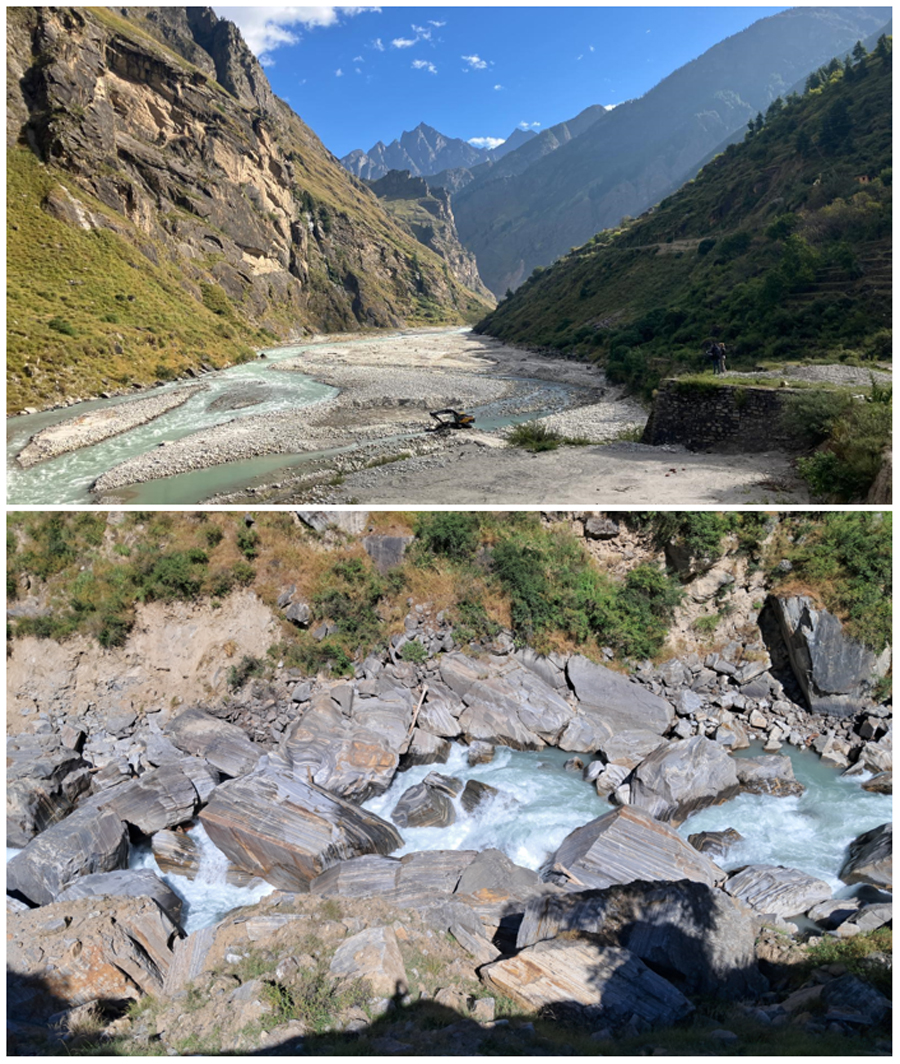
Dhauliganga river upstream (top) and downstream (bottom) of the knick point. Clearer contrast with wider bed and smaller rocks on the upstream to the narrow bed and boulders on the downstream portion. (Credit: Dr. Wolfgang Schwanghart (top) & Johann Kunzelmann (bottom))
On our final day, we visited Tehri Dam, operated by the Tehri Hydro Development Corporation Limited. Being the tallest dam in India with a height of 260.5m, it also has multi-faceted roles for irrigation, municipal water supply and generating electricity (capacity of 1000 MW). The visit to the power house of Tehri dam and direct interaction with engineers on the working mechanisms of turbines - an experience far beyond what can be acquired from textbooks.

Enjoying the pleasant Sun during our trek to Vasudhara Falls (left) and an animal’s skull with Vasudhara Falls in the background as a thin white line (right) (Credit: Abinesh)
To sum up, this enriching experience and knowledge from this Himalayan field school is very fruitful and I am also privileged to get this opportunity during my student time itself. There is a proverb in Tamil that loosely translated to “Where there is beauty, there is also danger” but Himalayan region, being beautiful, is highly susceptible to dangers (i.e., disasters) and these dangers are likely to occur more frequently with high intensity in future due to climate change. This highlights the need for increased research on hazard mitigation and resilience in the region, along with effective communication with policymakers. I extend my heartfelt thanks to the Project Investigators and coordinators of the Co-PREPARE project for granting me this opportunity for my first ever Himalayan visit.