
"The length of the journey has to be borne with, for every moment is necessary" - Georg Wilhelm Friedrich Hegel (Phenomenology of Mind)
As a PhD student, the opportunity to engage in international research is both exciting and enriching. Recently, I had the privilege of spending time in Germany for my research visit, which was made possible through the Co-PREPARE project. This journey not only advanced my academic pursuits but also allowed me to immerse myself in a new culture and forge valuable connections with fellow researchers. This was my second time visiting Germany, having previously spent time in Dresden during my master's studies (September 2018 - March 2019) under the DAAD scholarship.
Arrival in Germany
I was thrilled to land in Germany again, the first foreign country I ever visited. My host institute was the Deutsches GeoForschungsZentrum (German Research Center for Geosciences), or GFZ Potsdam. This is one of the eighteen Helmholtz centers across Germany. Living in the picturesque city of Potsdam was highly refreshing, with vibrant Berlin just 25 kilometers away. GFZ Potsdam is one of four research institutes located in the Albert Einstein Science Park on the Telegrafenberg hill. The proximity to researchers from various domains exposed me to pressing research topics and collaborative opportunities.
Research Activities
During my stay, I developed a climate-informed flood frequency analysis to estimate improved flood quantile values. I received combined guidance from Prof. Bruno Merz and Dr. Sergiy Vorogushyn. Our collaborative effort aimed to better understand and quantify the climate influence on flood extremes. Handling big data was integral to my work, and access to a high-performance cluster at GFZ Potsdam was crucial, significantly expediting my research.
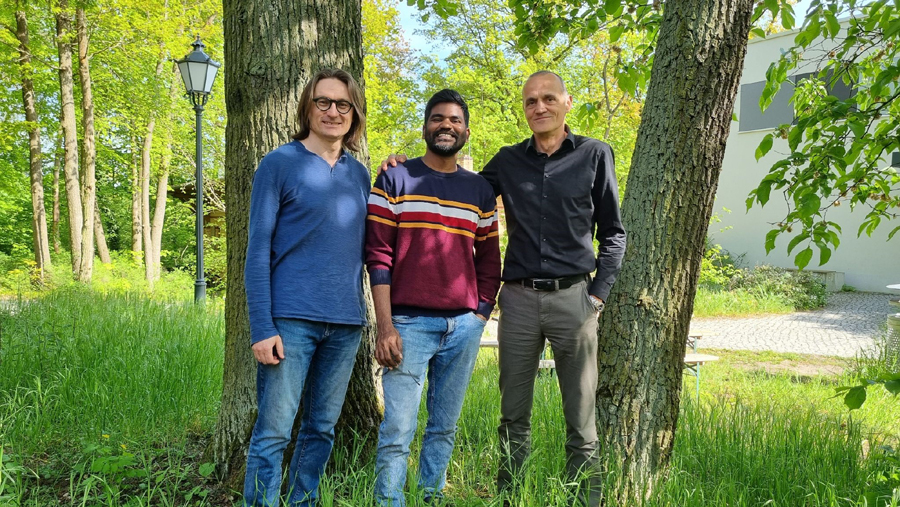
With Dr Sergiy Vorogushyn & Prof Bruno Merz near building C4, Albert Einstein Science Park
Research Communication
I attended three international conferences1,2,3 (EGU23 Vienna, IUGG Berlin and EGU24 Vienna) during my stay in Germany to present my research. I delivered an oral talk at one conference and presented posters at the other two. These conferences were incredibly enriching, providing inspiration for my future research endeavors.
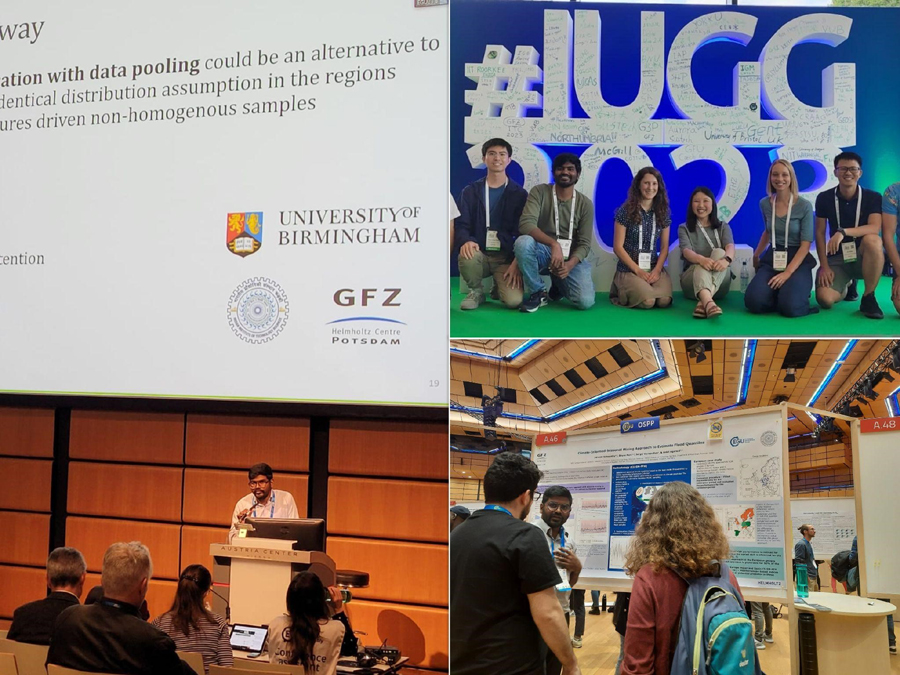
Snapshots of my oral presentation at EGU23 (left), in front of the IUGG sign with GFZ Potsdam colleagues (top right), and explaining my poster to researchers at EGU24 (bottom right)
The Inception of YHS India and Its Activities
At my first EGU23 conference in Vienna, along with Indian researchers, including Prof. Ankit Agarwal, we conceived the idea of creating a common platform for Indian hydrologists. We saw potential in the Young Hydrologic Society (YHS) and proposed starting the Indian chapter of YHS, leading to the inception of YHS India (https://younghs.com/national-initiatives/yhs-india/). I was appointed as the secretary of YHS India. So far, we have organized three webinars and convened a successful short course for EGU24.
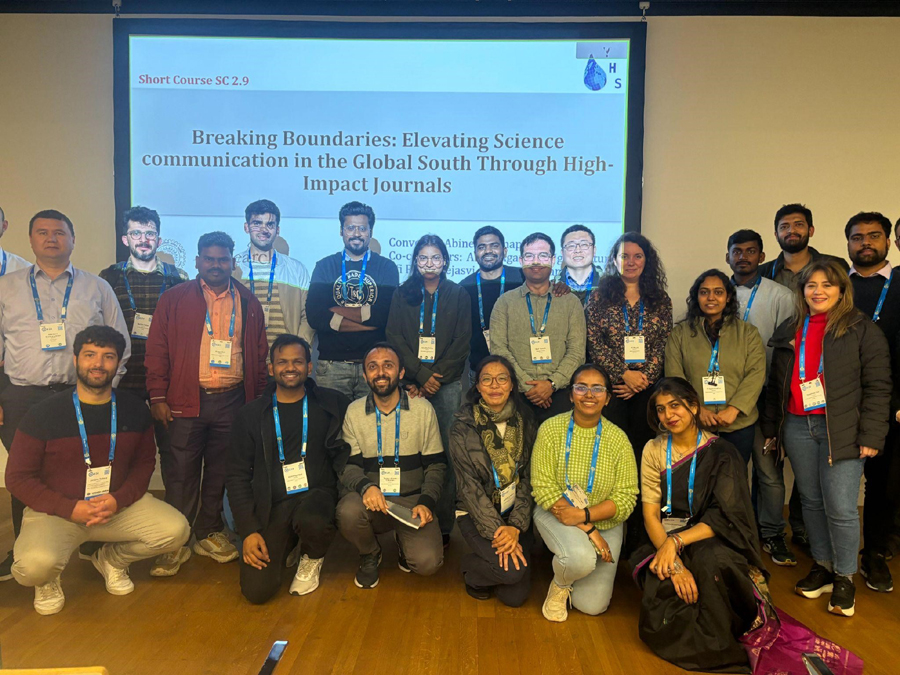
Group picture captured after completing our short course on science communication at EGU 24
Cultural Immersion
My experiences in Germany extended beyond my time at GFZ. I visited the 18th-century Sanssouci Palace and the Barberini Museum in Potsdam, which enriched my cultural experience. Teufelssee (Devil’s Lake), a 20,000-year-old lake, became my go-to place during the autumn for its serene hikes and peaceful evenings. I also visited the Natural History Museum in Berlin as part of monthly activities organized by the Welcome Center Potsdam. Additionally, I had the chance to learn some basics of the German language. The benefits of this research visit were manifold, from academic growth to personal development, and the memories created will last a lifetime.
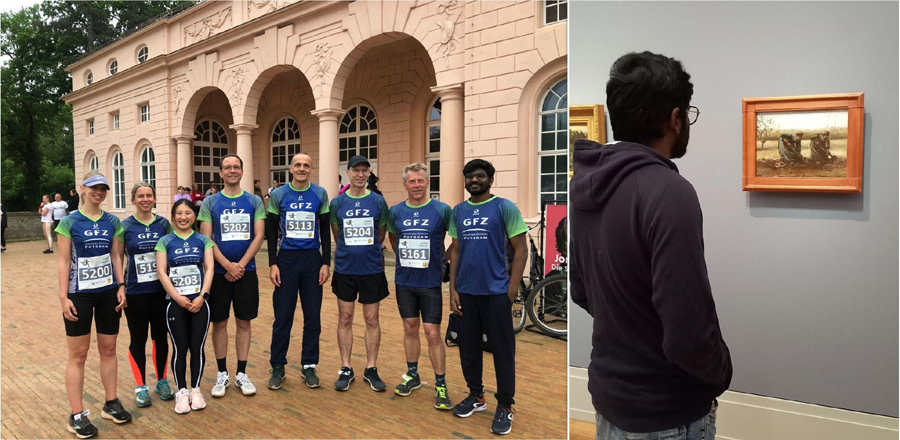
With GFZ colleagues for a 5KM corporate run (left) and a snap captured while immersing in a Van Gogh painting at the Museum Barberini
Acknowledgement & Thanks
I would like to thank Prof. Ankit Agarwal, Prof. Bruno Merz, Dr. Juergen Mey, Dr. Sangeeta, and everyone involved in the Co-PREPARE project for selecting me and providing the necessary financial support. Special thanks to the Welcome Center for clarifying all administrative and housing queries during my stay in Potsdam.
Acknowledgement & Thanks
- Abinesh Ganapathy*, David M Hannah, Ankit Agarwal. (2023). Flood frequency analysis integrated with unprecedented flood samples and mixed probability distribution. European Geophysical Union General Assembly 2023, Vienna, Austria, 24–28 Apr 2023, EGU23-4046. https://doi.org/10.5194/egusphere-egu23-4046
- Ganapathy, Abinesh., Hannah, David M. and Agarwal, Ankit: Hydrograph-based flood classification approach for flood frequency analysis, IUGG General Assembly 2023, Berlin, Germany, 11-20 July 2023, H09p-037, https://doi.org/10.57757/IUGG23-4674
- Ganapathy, A., Merz, B., Vorogushyn, S., and Agarwal, A.: Climate-Informed-Seasonal Mixing Approach to Estimate Flood Quantiles, EGU General Assembly 2024, Vienna, Austria, 14–19 Apr 2024, EGU24-1125, https://doi.org/10.5194/egusphere-egu24-1125, 2024.